Psychotherapy Practice Details

Dr. Berger believes that having a set of policies and procedures transparently open to his clients helps to provide a mutual understanding of how and what to expect when receiving psychotherapy. The psychotherapy practice details on this page are presented in the hopes that this will help to promote this purpose. Feel free to contact Dr. Berger if you have any questions.
ABOUT DR. BERGER
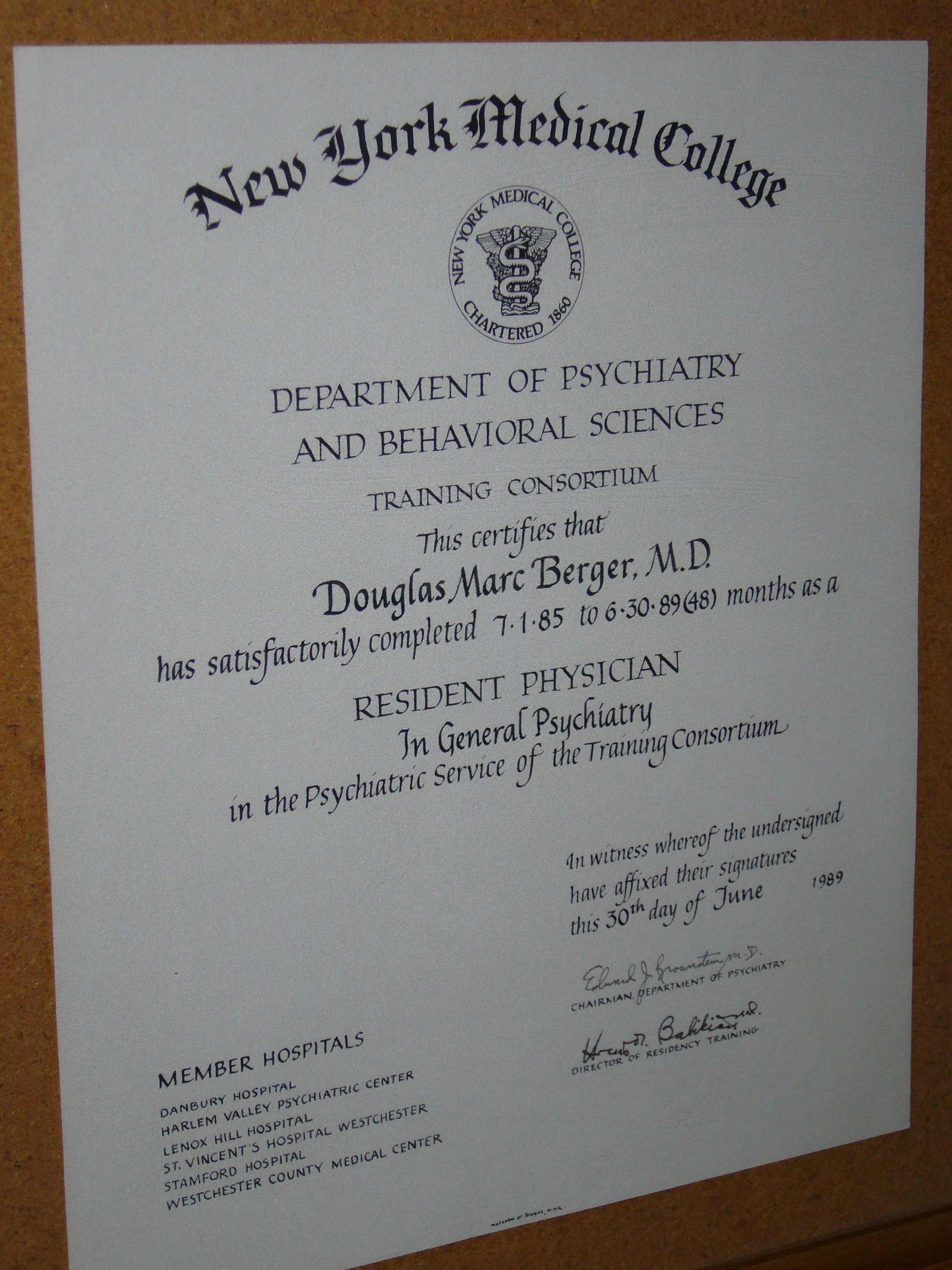
Dr. Berger graduated from the University of Connecticut with a bachelor's degree in biology and pathobiology, and then received his M.D. from New York Medical College. He completed residency in psychiatry also at New York Medical College, and did Fellowship training in the Department of Psychosomatic Medicine at the Albert Einstein College of Medicine Department of Psychiatry in New York. He is Board-Certified in Psychiatry from the American Board of Psychiatry and Neurology. Now based in Tokyo, Dr. Berger had served on the Faculty of the Albert Einstein College of Medicine Department of Psychiatry in New York as an Assistant Professor of Psychiatry. Dr. Berger has also received a Ph.D. from the Tokyo University Department of Psychosomatic Medicine for psychiatric research done in Japan. Please see the About Dr. Berger Page for more details.
JAPANESE MEDICAL LICENSING
Although Dr. Berger is a Board-Certified physician in psychiatry in the United States, he is not a licensed physician in Japan. Dr. Berger can do counseling and psychotherapy, and he can help guide and recommend any psychiatric medicines with the physicians affiliated with his practice, but he cannot directly provide medical care in Japan. There are psychiatrists in Japan who are licensed physicians, and anyone can seek help at a Japanese facility that has psychiatric services for medical care. In the case of severe depression or other psychiatric illness, Dr. Berger may refer clients for medication, similar to the function of a clinical psychologist in Tokyo.
Most international residents see Dr. Berger because of the language and cultural barrier of visiting a Japanese physician who usually only dispenses medication, and because the Japanese medical system does not provide for more than a few minutes of discussion with the doctor that is usually not considered adequate by Western standards. Counseling with Dr. Berger, however, should in no way be a substitute for licensed medical care when needed.
Because there is no comprehensive regulatory system for psychotherapists in Japan, it is important for those seeking therapy to confirm the credentials of their prospective therapists on their own:
You can also click here to see a cached version of Dr. Berger's Board Certification search results from the American Board of Psychiatry and Neurology website, or click here to see a cached version of Dr. Berger's Board Certification search results from the American Board of Medical Specialties website.




MEDICATION AND DIAGNOSES
Dr. Berger has considerable experience and knowledge on the use of psychiatric medications (anti-depressants, anti-anxiety medications, etc.) and can provide you with information and make specific medication recommendations to you if you have these needs. Dr. Berger works closely with a number of Japan-licensed physicians who can provide you with a prescription for these medications (the Japanese National Health Insurance will pay seventy-percent of the doctor and medication costs). Ordering of medication not available in Japan is also possible through this type of referral. If you decide to go to a licensed physician to receive medications, either in Japan or elsewhere, the physician who writes the prescription (or dispenses the medication) is finally responsible for that aspect of your care regardless of the referral from Dr. Berger.
Dr. Berger strongly advises that one only use medications while under the care of a licensed prescribing physician, and to consult with that physician in all instances regarding side effects, missed doses, dose changes, stopping medications, and any other aspect of medication treatment or medical care. In cases where medications are prescribed for psychiatric problems, it is Dr. Berger's policy to recommend that clients confer with their physician on the use of low-cost generic medications whenever possible. Please refer to the psychiatric medication referral page for further details.
Dr. Berger can provide you with a letter from a U.S. qualified psychiatrist associated with a counselng center located in Japan. If a letter is required from a medically-recognized Japanese M.D., a licensed physician affiliated with Dr. Berger with can write you a Certificate of Diagnosis ("Shindansho" in Japanese). In addition, although the name of a condition (i.e., depression) may be presented to you in the context of symptoms you describe, diagnoses in psychiatry are used for the working purpose of treatment decisions, are tentative in nature, the diagnostic system used in psychiatry is still under debate, and there are no confirmatory tests or ways to prove a psychiatric diagnosis. Diagnostic terms may also be presented to you related to people you describe in order to give you ways to understand these persons. Note however, that these diagnostic terms are only tentative concepts, subject to the problem of your therapist not being able to examine the person(s) in question directly, are not official medical diagnoses, and do not mean these persons actually have these disorders.
APPOINTMENTS, FEES, AND INSURANCE
Appointments are necessary for all counseling sessions, please contact Dr. Berger for further information. Therapy hours are by appointment and include mornings and evenings Monday through Thursday (until 11:00pm), and mornings on Friday, Saturday, and national holidays.
Dr. Berger strives to maintain therapy costs as low as possible. Overhead costs are kept to a minimum, and clients are seen as infrequently as optimal care will allow (usually once or twice a month). Fees are due in cash at the time of service, or in advance in the case of phone/Skype sessions. Please inquire about the current fee structure. Although the Japanese National Health Insurance does not cover counseling services, fees can often be partially or fully reimbursed to you if you have an international insurance plan. Please inquire with your plan whether individual psychotherapy is covered. Many Westerners in Japan sign up with the U.S. based Cigna International plan or the ProtExPlan, or the New-Zealand based InterGlobal plan; please confirm the plan that is right for you. A receipt template and a diagnostic code will be issued to you to fill in at no charge if you request receipts for insurance coverage. Specific fees would be requested if you request Dr. Berger to fill in the data.
Fees received in advance by wire, cash-post, or PayPal, are considered fees for contracted services, may be used for a maximum period of 3 months as credit for services, and are not refundable. Checks are not accepted. Credit cards are only accepted in the case of pre-payment or missed session payment, and only when transacted through PayPal.
In the case you have an International (non-Japanese) Medical Insurance plan, I will issue a receipt template to you by e-mail after the first session that includes a diagnostic code and request you add this and the session dates and bring the receipt to me to sign when you need them. There is no fee for the receipt template, or for me to sign them. I would request a 2,000 yen administrative fee each time you request I fill-in the templates and print them. These receipts are usually satisfactory and as a general rule I would not need to fill-out your insurance forms unless your insurance company replied to you that the receipts were not acceptable. There is no fee if you fill-out insurance forms and only request my confirmation and signature. I would request 4,000 yen administrative fee per instance in the case you request that I fill-out insurance forms; alternatively we can fill them out together during a therapy session time at no extra cost.
In the case of therapy with minors (less then 20 years-old in Japan), the appointment would generally need to be made with the consent of at least one of the parents. While it is best if both parents know and are involved in the consent for therapy, any disagreement between the parents on whether their minor child should have therapy or not would be an issue that the parents would need to resolve between themselves, and the parent making the appointment would still be responsible for any session or cancellation fees. However, if the person requesting therapy is over 18 years-old and considered an adult in their home country, it may be possible for the person to consent to therapy by presenting their passport and writing a note that they agree to be considered an adult as in their home country. Whether this is feasible will be determined on a case-by-case basis by the assigned therapist.
CANCELLATION POLICY
Because making an appointment means the time will be held for you, it is necessary to have a system for clients to be fair to each other and to Dr. Berger in utilizing the session hours. The cancellation policy for the first session would be the full fee for the session once you make the appointment either by phone or by receipt of a confirmation e-mail from Dr. Berger. Cancellation for ongoing therapy is requested 72 hours in advance of your appointment. Please note that rescheduling is also regarded as a cancellation. If you were to cancel or reschedule within the specified time, the full-fee for the scheduled session would be requested, payable within one week of the missed session by bank transfer, PayPal, or cash-post (genkin kakitome) from the post office, regardless of the reason for the cancellation. In addition, all appointments are confirmed times, there are no provisional or tentative appointments unless noted otherwise in writing. Your understanding and cooperation in this regard is greatly appreciated.
As e-mails may be delayed or not go through, please be sure to confirm any e-mail cancellation by phone message if you are near the 72 hours prior to your appointment or if you do not receive a prompt reply. In addition, session appointments are mutually understood to imply a need for care, i.e. it would not be an appropriate use of the session appointments for the purpose of contemplating a need for care with a plan to cancel the session before the 72-hr deadline if no need is then considered.
It is Dr. Berger's policy to be completely open and fair with all fee and billing policies. The policy is noted here on the web page, will be repeated verbally at the time of making a first appointment, it is noted in the e-mail for the first appointment notice, and will be noted on an Informed Consent provided at the first visit. Sessions are only scheduled at the request of and with the agreement of the client. Please be sure of your intention to have a session when you make appointments.
ADVICE AND THERAPEUTIC EFFICACY
Dr. Berger may occasionally provide you with suggestions or advice regarding work, family, personal relationships, or other topics. Although Dr. Berger will try to advocate for you based on his understanding of your personal situation and psychological issues, advice should be taken with the caveat that Dr. Berger cannot necessarily predict what might benefit someone in an actual real-life situation. Because of this, you would need to make your own personal decision in acting on any advice received from Dr. Berger in a psychotherapy session, or from any outside agency (medical, legal, foreign residents' advisory, etc.) that Dr. Berger may have referred you to. Also, note that this web site and any associated web sites are for the purpose of information only. All medical, psychiatric, and mental health needs require consultation with the appropriate professional.
In addition, all non-emergency issues (i.e., other than worsening of symptoms, acute medication side effects, immediate risk for harm to self or others, etc.) should be consulted on in the face-to-face sessions, rather than in an e-mail or phone call, so that the discussion can be put in context of the entire situation, and where there is the time to evaluate all the details thoroughly.
Regarding therapeutic efficacy, although Dr. Berger conscientiously uses the most up-to-date methods in his counseling approach, there are inevitably conditions that do not improve for a variety of reasons making any guarantee of efficacy difficult. These reasons may include the nature of the condition itself, the client's insight into the problem and/or willingness to undertake recommended treatments, the ability of the therapist and/or treatment to effect gains, or advice that does not meet the client's expectations. While fees for unsatisfactory sessions can not be refunded, it is the client's free choice to discontinue further meetings with Dr. Berger and/or request to see another therapist.
Unfavorable outcomes including worsening of condition or other untoward effects, psychosocial or occupational impairment, and even suicidal behaviors may be seen even when one is receiving the accepted standard of care. On rare occasion, clients may react in disagreement or unpleasant surprise in being told they likely have an illness such as depression, manic-depression, alcohol abuse, etc. Dr. Berger's policy is that it is ultimately in the client's best interests for gentle, but clear and transparent information sharing with clients in this regards, even if there is the risk that a client may show discomfort in receiving this information. If a client feels suicidal, homicidal, or that they might hurt themselves or others in any way, they are welcome to Dr. Berger, but they must leave a written e-mail notice with Dr. Berger to ensure that he can then take appropriate action if he is not available by phone.
CONDITIONAL THERAPY AND THERAPY TERMINATION
Dr. Berger may need to put conditions on a client's receiving counseling, may not be able to provide counseling, or may need to terminate ongoing counseling. These situations include danger to self or others (i.e., suicidality, intent to harm property or others, etc.), chronic inability to readily contact a client, or other disturbances to the therapy etc., that need to be determined by Dr. Berger on a case-by-case basis. Confidentiality may need to be broken in serious cases of threat to self or others to protect those concerned.
If possible, termination of ongoing therapy should be discussed in the context of your situation during a therapy session. If you decide to terminate your therapy by e-mail or leave a message to this effect on Dr. Berger's answering machine, it would be appropriate practice for Dr. Berger to call you and inquire about your status and needs for referral elsewhere. Dr. Berger also reserves the right to send you a follow-up e-mail if he has some specific concern about your condition and needs to document he has informed you to receive a specific therapy or intervention.
EMERGENCIES AND HOSPITALIZATION
The number to call an ambulance in Japan is 119, for the police it is 110. If you or a significant other has an urgent medical or psychiatric situation and you cannot readily contact Dr. Berger, you should either contact your medical physician, visit a hospital emergency room, or call an ambulance or the polic as soon as possible. Most all university hospitals have emergency rooms and psychiatric wards. One hospital with emergency services is the Tokyo Metropolitan Hiroo General Hospital (Tel: 03-3444-1181) in Minato ward located walking distance from the Hiroo subway station or a short Taxi ride from either the Ebisu or Meguro JR Yamanote line train stations. The U.S. Embassy also has a helpful list of hospitals in Tokyo.
The problem is that most of these hospitals will likely tell you to find a psychiatric hospital and will not easily allow you inside the emergency room unless you are quite adamant you will hurt yourself and/or note to them that the Medical Doctor Law No.19 ("Ishihou Ju-Kyu Jou") stipulates that doctors can not refuse to see patients. You may do better by calling the Tokyo Metropolitan Health and Information Center called "Himawari" which also has an English line at: 03-5285-8181 to find a hospital that will accept you for psychiatric reasons, although it can take some time to effect acceptance from a hospital. A private ambulance company, Zen Nichi Kyu (Tel: 0120-340-560), may be helpful in involuntary admission cases in Japan where the family has already made arrangements with a specific hospital. SOS International may be helpful for non-Japanese that require escorted repatriation to their home country.
For clients being seen by Dr. Berger, in the case that you or a significant other requires psychiatric hospitalization, Dr. Berger can provide you with the names of some Japanese hospitals for your reference. However, as Dr. Berger does not work directly with the physicians in these institutions, nor have any specific ability to effect hospital admission, he can not guarantee which hospital will actually accept a specific patient, the adequacy of the care provided, the ability of the staff to speak English, nor take responsibility for the care received from these medical facilities. Fluency in Japanese, as well as participation in the Japanese National Health Insurance, are key factors in the likelihood of being accepted for psychiatric hospitalization.
While Dr. Berger will conscientiously help you with advice in these cases, the procedure for in-patient hospital admission is something that in the end is up to the patient and/or significant others to effect via contacting hospitals, taxi, police, ambulance, etc. You may also want to contact your embassy for advice and assistance. If there is ongoing risk of need for admission to a psychiatric ward and the person in question does not have good command of Japanese, then it is prudent to consider repatriation to one's home country before an emergency arises.
For first-time inquiries, as it is impossible for Dr. Berger to understand your exact needs over the phone or e-mail, you would need to make a personal decision on what kind of hospital, doctor, or medical treatment you think you need if you have an emergency or require hospital admission. You may use the information and links on this page to guide you, and you can reference the medical information provided on the various Tokyo embassy web sites (U.S., Austrailian, Canadian, etc.).
If you are trying to effect admission to a hospital for someone who does not wish to go to a hospital, even if that person is clearly in a bad state of mind, drinks heavily, may feel significantly suicidal etc., it is practically impossible to get them admitted against their will. Neither the police nor an ambulance are likely to forcibly bring a person who does not wish to be admitted unless there has been a clear event of danger to onseself or other with noticible and significant consequences of physical injury and/or damage to objects. Unfortunately, many of these persons will fall thru the cracks in the system.
CONFIDENTIALITY
Confidentiality is defined as the maintenance of privacy between one's therapist and a client about the fact that they are consulting with the therapist, as well as the details of the consultation. Assignment to therapy with one of Dr. Berger's associates indicates that the client consents to the fact that the assigned therapist may need to discuss any and all of their clinical information with Dr. Berger.
Dr. Berger and his associates form the Meguro Counseling Center and all clients are seen in affiliation with this center. The Meguro Counseling Center is an associated network of therapists who work independently but share clinical support functions that include educational meetings, professional literature, mutual consultation on specific clients’issues, and other related activities in the service of providing the best care possible. The therapists at the Center will also cover for inquiries, emergencies, and correspondence for each other, and will confidentially share client lists, phone numbers, and clinical information in this regards. In the service of good clinical practice, Dr. Berger may have an associate therapist from the Meguro Counseling Center follow-up with client inquiries and cases of therapy termination by the client.
Confidentiality is strictly maintained with the following caveats:
Please also refer to the Meguro Counseling Center Code of Ethics page for further details. Note: the content of this site is for information purposes only. None of the content of this site, or Dr. Berger's related sites, is meant to be therapeutic or medical advice.